Article
Un Chien Andalou (1929) By Mitchell, Ryan Robert
Article
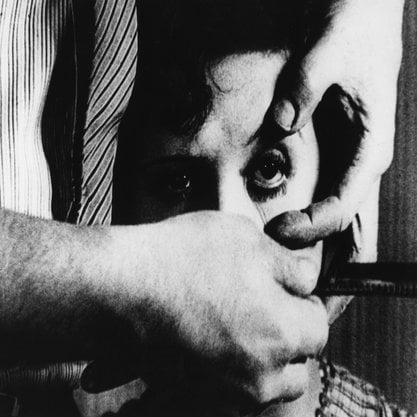
Un Chien Andalou [An Andalusian Dog] (1929) is a short Surrealist film by Luis Buñuel and Salvador Dalí, who collaborated on the scenario. The opening sequence of the film is one of the most famous within the experimental film tradition: the image of a thin sliver of cloud crossing in front of the moon is then immediately doubled by an extreme close-up of a straight razor slashing open a woman’s eyeball. This sequence exemplifies one of the Surrealist intentions for cinema, as Buñuel would later claim, to ‘express the world of dreams, of emotions, of instinct’ (Buñuel 1958: 138). For the Surrealists, one of the revolutionary goals for art and politics was to liberate both desire and imagination, allowing the spectator to see the world with a new eye unconditioned by repressive bourgeois morality. The rest of the film, which purposefully defies any coherent narrative or definitive interpretation, is full of images intended to shock and disrupt the spectator’s supposedly safe position: ants crawl out of a hole in a man’s hand; a man pulls two grand pianos holding dead, rotting donkeys with two live priests dragging behind; a beautiful androgynous woman casually pokes at a severed hand with a stick before being hit by a car. Buñuel was incensed that his film was positively received by bourgeois critics as a titillating aesthetic experience, notoriously stating that they ‘found beautiful or poetic something that was basically a desperate, passionate call to murder’ (Buñuel 1929: 34). While this work was one of the few uncontested films within the so-called Surrealist film canon, its subsequent influence was felt in diverse and disparate examples, such as the experimental film and video tradition, music videos, and filmmakers like David Lynch and Guy Maddin.